In today’s article, I’ll show you how I build my keyword list and find low-competition keywords to rank on the first page of Google.
I will also include the tool I use and show you how to leverage Google suggestions to give you content ideas.
First things first, is it necessary to create such a list?
Absolutely, and there’s two reasons for it:
- You are just starting and want to drive traffic to your website, or you already have a website and looking to increase the traffic flow.
- Because traffic is the first step towards a successful online business, it is essential to create relevant content that people are searching for.
Creating content for the sake of populating your website will lead you nowhere.
There are 2 types of traffic:
- Paid: As the name implies, you can pay for traffic. There are two categories of paid traffic: PPC, when a user clicks on your ad and visits your site, and PPM, where you pay per 1000 impressions.
- Advantages: You get traffic flowing to your website instantly. A quick way to test an idea. (this can be a new product, a landing page, a new design of the website, etc)
- Disadvantages: The traffic you just paid for will plummet once you stop spending money.
- Organic: Unlike the paid option, organic traffic attracts people to your website. The key to doing this is to write good content, build backlinks (other website links back to your site), and optimising that content for the search engine.
- Advantages: The content will attract visitors for the years to come and help you become an authority.
- Disadvantages: It will take months for your content to rank.
In order to get organic traffic, we have to populate the website with good-quality content.

The question is:
How do we know which content is relevant, and where do we find enough content ideas to build a steady stream of traffic?
The answer is Keyword Research!
Now, how about we build one?
How to build a keyword list [with example]
Let’s say I have interested in renewable energy and have a business selling solar panels. I want to write blog posts on my website because I don’t want to pay for traffic, and I want to build a community.
The first step is to start by brainstorming some ideas.
I start by determining the search intent behind the search.
Search Intent represents the reason why someone is searching for specific information.
The importance of Search Intent
So how search intent looks like in our example?
First, I need to get into the mind of the consumer. I do this by answering the following question:

What are the main reasons people are buying solar panels?
- The price of electricity goes up, and people are looking to cut costs.
- More and more families want to become self-sufficient.
- It reduces the carbon footprint.
Then, I would educate them on the different types of solar systems:
- Solar Thermal: these panels turn sunlight into heat, and they help reduce monthly heating bills.
- Solar Photovoltaic: these panels are more commonly used as they turn sunlight into electricity.
Second, I put myself in their shoes and answer the questions I would have if I were to buy Photovoltaic Panels as follows:
- How many types of Photovoltaic Panels are there?
- How much does it cost?
- What brands are selling them?
- Types of Photovoltaic Panels.
- Monocrystalline: These Panels are built from single silicon crystals, making them more efficient (they produce more power per square foot) than other types of panels.
- Polycrystalline: These panels are made from multiple silicone sources and are not as efficient as the Monocrystalline ones.
- Thin Film: Although Thin Film panels perform better in lower light and shade than Monocrystalline and Polycrystalline panels, they are not as efficient.
- Cost
There is no definitive answer, as the cost depends on the roof size, the type and number of panels, and the installation which can cost more than the system itself. The price ranges are as follows:
- Monocrystalline ranges between $3 and $3.50 per watt or $19.000 for a 6kW system.
- Polycrystalline ranges between $3 and $2.80 per watt or $17.000 for a 6kW system.
- Thin Film ranges between $3 and $2 per watt or $17.000 for a 6kW system.
- Brands
(For our purpose, I’ll name just a couple)
- LG, Sharp, Panasonic, and Sunpower.
The reason behind researching, brainstorming, and taking notes is to get more information about the consumer and understand his why.
So far I know:
- Types of solar panels.
- Which solar panels are more popular.
- The average price.
- Popular brands.
I use this information to create relevant content for the consumer at any stage of decision-making. Topics such as: top 5 brands, what system is ideal if you’re on a budget, or the difference between a 6kW and 8kW system, and so on.
If you want to go the extra mile in understanding your consumer, I highly recommend reading the article: In Depth Market Research.
I now have a rough idea of the consumer’s why and what. But I need more information to build a relevant keyword list.
The second step is to use the keyword tool to find keywords I can rank for.
Let’s get technical!
Tools for finding competitor keywords
In order to do effective keyword research, you need tools. They are a must, especially if you’re playing the SEO game.
I pay for my keyword tool because I find it better than other free options and I find myself using it quite often. The limited searches I’d get with a free tool wouldn’t work for me.
There are a couple of tools out there. I would advise you to try them and stick to what works for you.
Popular SEO tools
Here are some of the most popular SEO tools and how much is the monthly subscription:
- Ahrefs – Starting from: $99/mo
- Semrush – Starting from:$119.95/mo
- Moz – Starting from: $99/mo
- Surferseo – Starting from: $59/mo
- Kwfinder– Starting from: $49/mo
I use Kwfinder. It has a simple, intuitive design, and more importantly, it doesn’t cost as much as the other tools.
Again, try them and use the one you like the most, or if you know another tool, use that one.
Ok, back to our example.
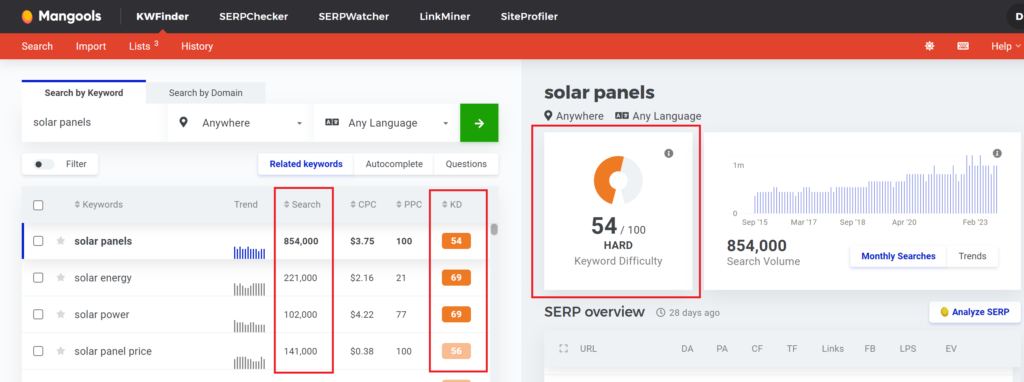
Straight away, we can see the difficulty of our keyword “Solar Panels” which is HARD. So, ranking for that keyword is quite impossible in the given situation.
You’ll notice that each keyword has a search volume and colour (the colour represents the difficulty). You’ll also see that some colours are lighter than others, reason is that the keyword difficulty has not been updated in some time (just click on it to update it).
Quick note. Because I’m showing you how to do keyword research, I’m not going to analyse all the low-difficulty keywords, something you absolutely should do.
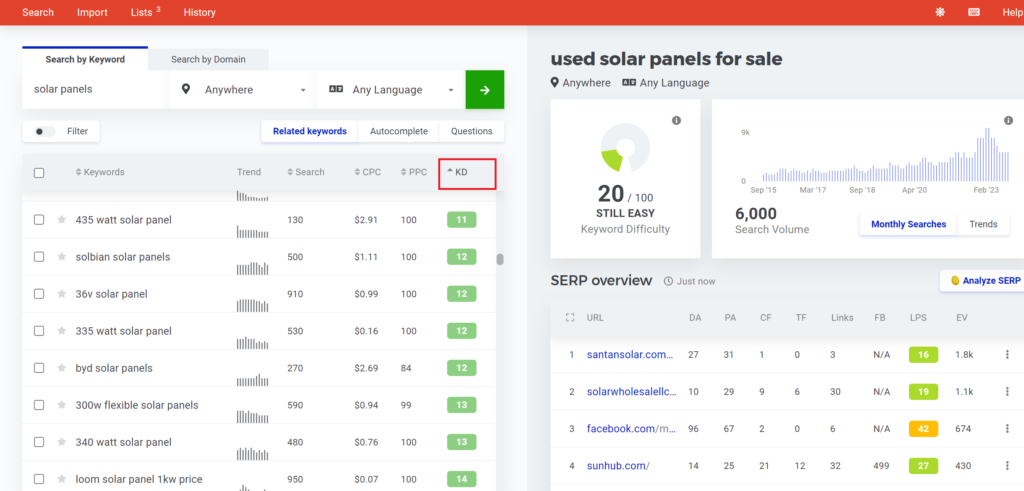
We start searching for keywords with a KD (keyword difficulty) of 25 and lower, and a good search volume. (Click on the KD button to sort by difficulty).
There we go:
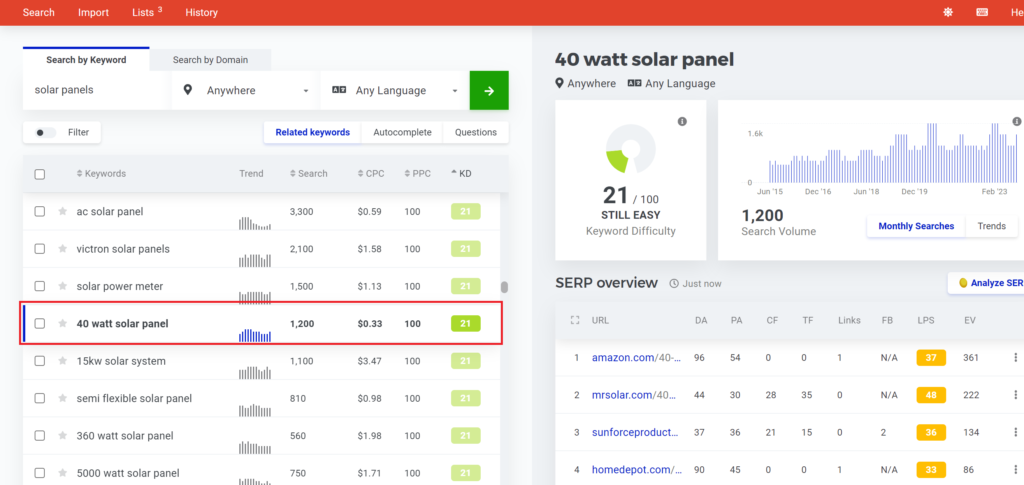
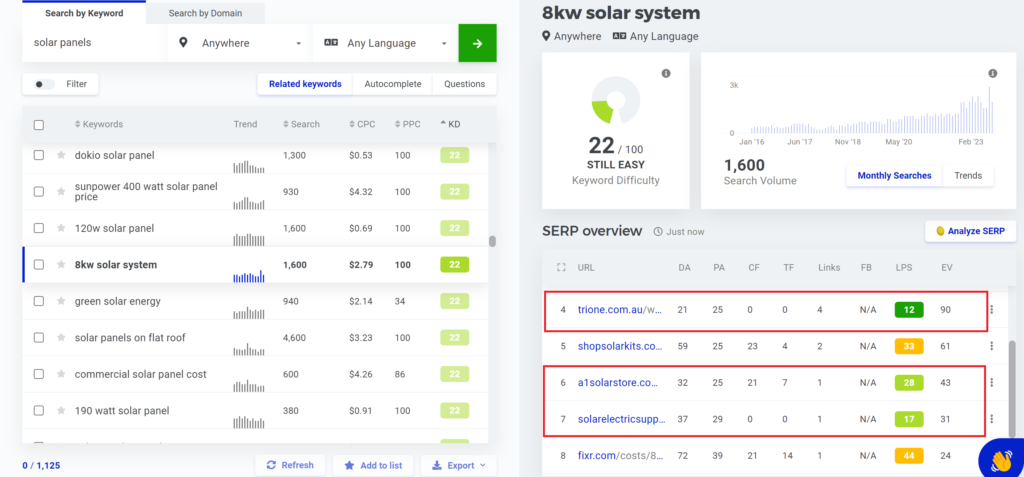
At the bottom right, you’ll see the websites that rank on Google. We pay attention specifically to the ones in green because the main reason why they ranked is that they have good content. Go visit them and see how they laid out the content. Do this for all the websites on page one, not just the green ones!
Your competition is paying $2.79 per click, and you can get similar clicks to your website for free!
Leveraging Google suggestions
Another way to find keyword ideas is with the help of google itself!
(I prefer opening a new tab in Incognito mode so that my suggestions won’t be influenced by my search history.)
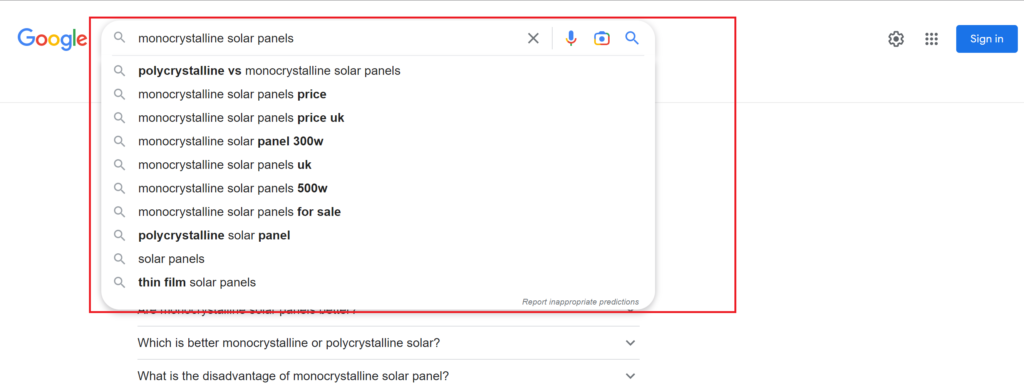
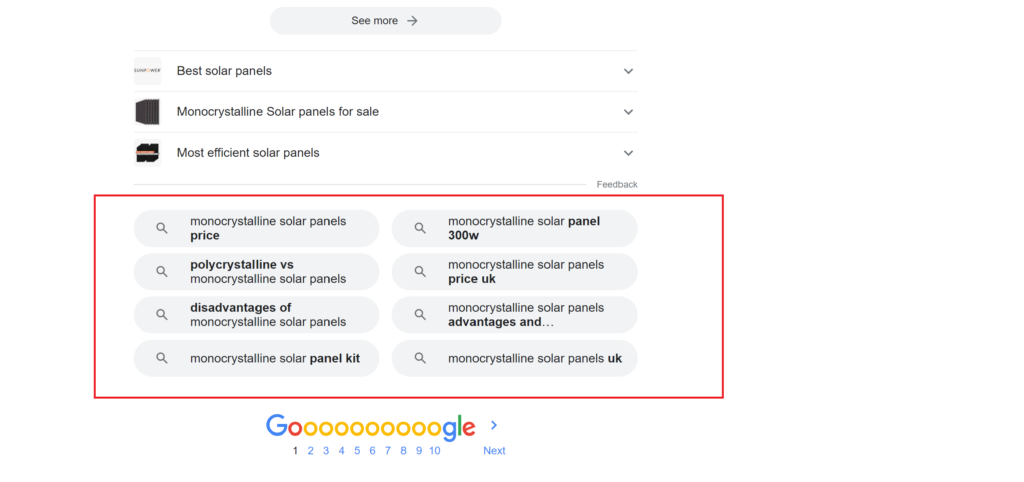
Just type the keyword into the search bar and see what Google autosuggests. After you write them down, scroll to the bottom of the first page to get related searches.
Congrats!
Now you know why a keyword list is vital for your website to rank and how to create one!
Conclusion
In order to rank organically on the first page of Google, you need to create content that people are searching for. But helpful content itself is not going to rank your page, you have to find words that have high volume search and that the big companies are ignoring.
By ranking organically, you get a competitive advantage over your competitors. You’ll get good quality leads and establish yourself as an authority in your industry. All of that without spending a great deal of money.
Get going and take what’s yours!
If you found this useful, send me a message on socials or Email.
Dragos.